
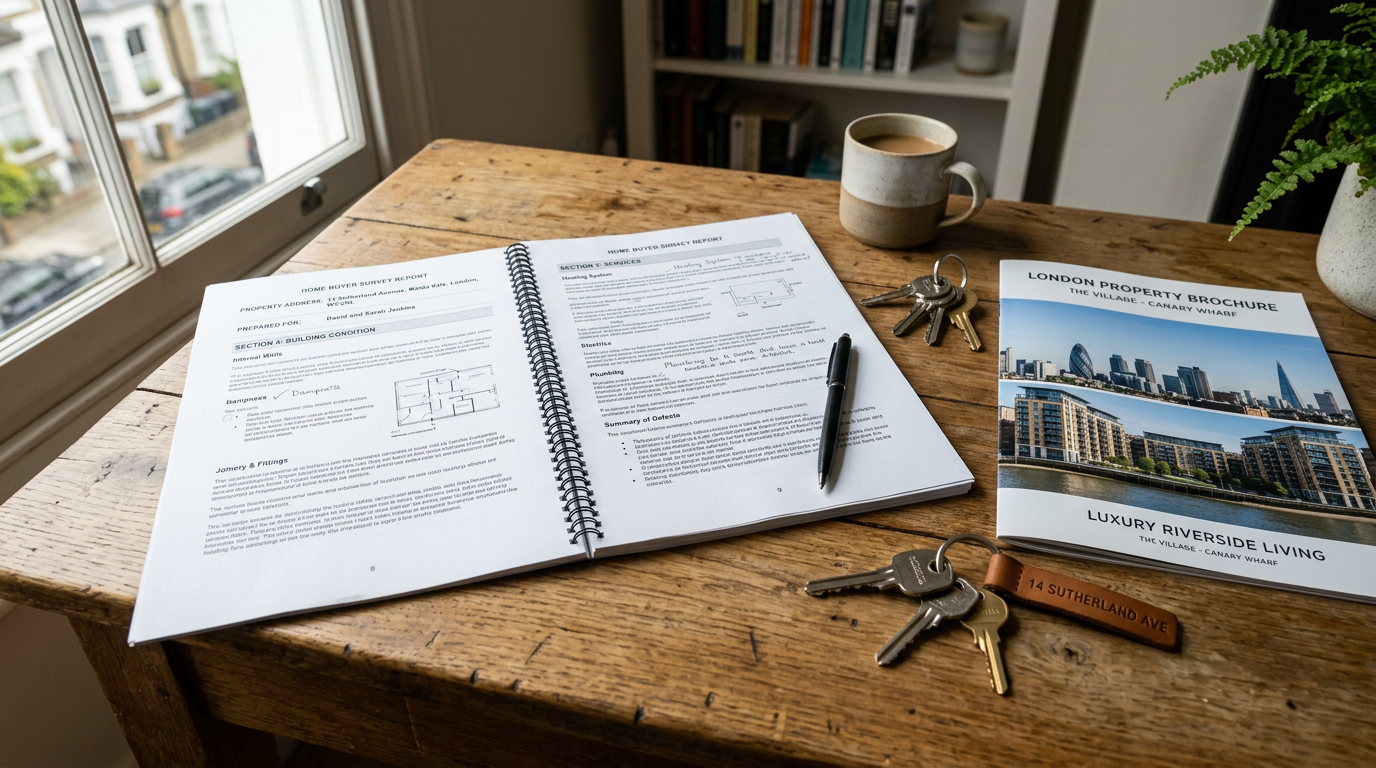
If you're buying a property in Pimlico, or anywhere else in London, the phrase "get a survey" will come up pretty quickly. But with three main types of RICS survey available — and plenty of conflicting advice online — it can be hard to know what you actually need.
In this guide, we'll explain exactly what a RICS HomeBuyer Report is, what it includes, when it's the right choice, and what to do once you've received yours.
What Is a RICS HomeBuyer Report?
A RICS HomeBuyer Report — formally known as a Home Survey Level 2 — is a mid-level property inspection carried out by a qualified RICS surveyor in accordance with RICS (Royal Institution of Chartered Surveyors) guidelines. It sits between a basic Condition Report (Level 1) and a full Building Survey (Level 3).
The report uses a clear traffic light rating system — red, amber, and green — to describe the condition of each element of the property. This makes it much easier for buyers to quickly understand what's urgent, what needs monitoring, and what's fine.
Think of it as a knowledgeable friend's frank assessment of a property — written down properly.
What Does a RICS HomeBuyer Report Cover?
A standard HomeBuyer Report covers all the key visible and accessible elements of the property. Your surveyor will assess:
- The structure: walls, roof, floors, and ceilings
- The services: heating, electrics, gas, drainage (visual inspection only)
- The interior: ceilings, walls, floors, fireplaces, built-in fittings
- The exterior: roof coverings, chimneys, rainwater goods, windows and doors
- The grounds: paths, boundaries, outbuildings, retaining walls
- Legal issues: items to draw to your solicitor's attention
"I always tell clients to think of the HomeBuyer Report as exactly what it sounds like — a report written for a home buyer, not a building professional. It's designed to be readable, actionable, and genuinely useful."
— James Hartley, Principal Surveyor, Pimlico Surveyors
What Doesn't It Cover?
It's equally important to know what a HomeBuyer Report doesn't do. It is a visual, non-invasive inspection — the surveyor will not lift floorboards, move furniture, or access areas that aren't readily accessible. The report won't include:
- A structural engineer's analysis of significant defects
- Detailed assessment of services (boiler testing, electrical testing)
- Invasive investigation of suspected defects
- Estimated repair costs (these are included in a Building Survey)
If the surveyor identifies something that warrants further investigation — a suspected drainage problem, cracks that suggest movement, or damp that needs specialist testing — they will recommend that you commission additional specialist reports.
When Is a HomeBuyer Report the Right Choice?
A HomeBuyer Report is generally appropriate for:
- Conventional properties built after around 1930, in good condition
- Modern flats and apartments in purpose-built blocks
- Properties where you want a cost-effective, reliable survey without the detail of a full Building Survey
It's probably not the best choice if:
- The property is a pre-1930s Victorian or Georgian terrace
- You've noticed signs of structural movement, damp, or major disrepair
- The property is of unusual or non-standard construction
- You're planning significant structural works
In those cases, a RICS Building Survey (Level 3) is likely the better investment. When we provide quotations to clients, we always ask about the property and give honest advice about which survey type is most appropriate.
Can I Include a Valuation?
Yes — a market valuation can be included in your HomeBuyer Report as an optional extra. This gives you the surveyor's independent view of the property's open market value at the time of inspection. It can be useful as a negotiating tool, or simply for peace of mind.
We also offer the option of a reinstatement cost assessment (also called an insurance reinstatement value), which tells you what it would cost to rebuild the property from scratch — useful for ensuring you have the right level of buildings insurance.
What Happens After the Report?
This is where many buyers get confused. Receiving a survey report that highlights issues doesn't mean you should panic and pull out of a purchase. It means you're now better informed than before.
Common next steps include:
- Renegotiating the price: If significant defects are found, you may be able to ask the seller to reduce the price or complete repairs before exchange.
- Commissioning specialist reports: If the surveyor recommends further investigation — from a structural engineer, damp specialist, or electrician — arrange these before exchange.
- Proceeding with confidence: If the report is broadly positive, it gives you the reassurance to proceed knowing what you're taking on.
At Pimlico Surveyors, every HomeBuyer Report comes with a complimentary post-report consultation call. We're always happy to walk clients through the findings and advise on next steps.
How Much Does a RICS HomeBuyer Report Cost?
Fees for a RICS HomeBuyer Report in London typically range from £400 to £700, depending on the size and location of the property. We provide fixed-fee quotations — no hidden costs — so you'll know exactly what you're paying before we start.
Request your free quotation here.
FAQ: RICS HomeBuyer Reports
For a standard property, the inspection typically takes 2–3 hours. The report is delivered within 3–5 working days.
Yes — you're welcome to join us at the end of the inspection for a brief verbal overview. We ask that you aren't present during the main inspection, as this allows the surveyor to focus fully on the property.
A HomeBuyer Report is a buyer's survey — it is separate from a mortgage valuation. Most mortgage lenders carry out their own basic valuation independently. However, if issues in your survey affect the value, your lender's valuer may flag them too.