
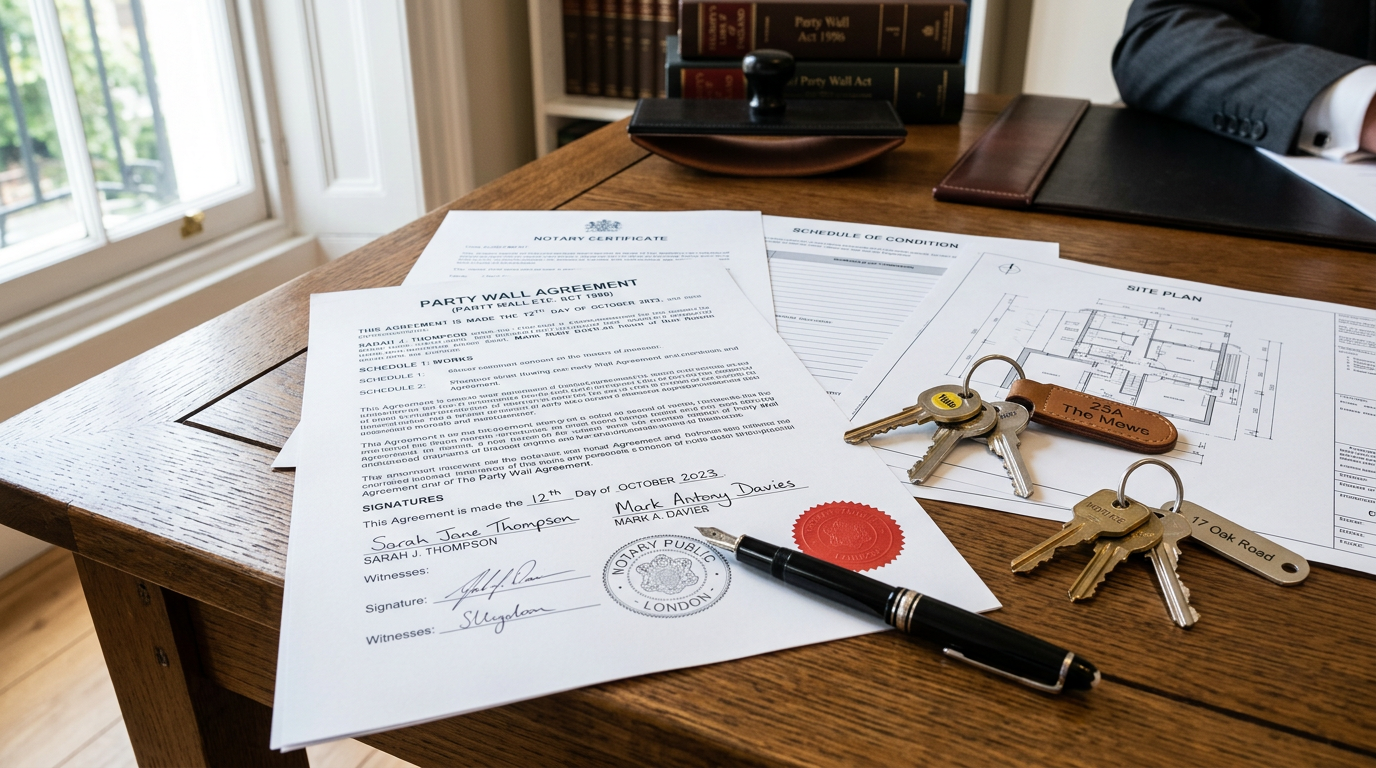
I've been a party wall surveyor for nearly a decade, and I can tell you that the number of homeowners who begin building works without serving the correct party wall notices is remarkable. Even more remarkable is the confusion and expense that follows. So let's clear things up — here's everything you need to know about the Party Wall etc. Act 1996 in plain English.
What Is the Party Wall etc. Act 1996?
The Party Wall etc. Act 1996 is a piece of legislation that governs building works affecting shared walls, boundaries, and excavations near neighbouring properties in England and Wales. It exists to protect both building owners and their neighbours from disputes about building work — and to provide a clear resolution process when disagreements arise.
The Act covers three main types of work:
- Works to an existing party wall or structure (e.g. cutting into it, raising it, underpinning it)
- New buildings on or at the boundary
- Excavations within 3–6 metres of a neighbouring property's foundations
If your planned building project triggers any of these, you are legally required to serve notice on your neighbours before work begins.
Do I Need to Serve a Party Wall Notice?
Common projects that typically require a party wall notice include:
- Rear extensions (single and double storey)
- Loft conversions involving the party wall
- Basement excavations
- Underpinning
- Installing beams or steel supports in the party wall
- Building a new garden wall on or near the boundary
If you're unsure whether your project requires a notice, we offer free initial advice — just get in touch.
The Notice Process: Step by Step
Here's how the party wall notice process typically works:
- You serve notice on all affected neighbours. There are different notice forms depending on the type of work. Notices must be served at least 1–2 months before work begins.
- Neighbours respond within 14 days. They can consent in writing (in which case no surveyor is needed), or they can dissent — either expressly or by not responding at all.
- Surveyors are appointed if consent isn't given. Each party appoints their own surveyor, or both parties can agree to appoint a single "agreed surveyor."
- A Party Wall Award is agreed — a legal document that sets out how the works are to be carried out, access arrangements, and the rights of each party.
- Works proceed in accordance with the Award.
"The party wall process doesn't have to be adversarial. In the vast majority of cases I deal with, both parties agree quickly and everyone gets on with their lives. The Act is there to protect people — not to cause arguments." — Sarah Pemberton, Pimlico Surveyors
The Importance of a Schedule of Condition
One of the most important — and most overlooked — parts of the party wall process is the Schedule of Condition. This is a photographic and written record of the neighbouring property's condition before work begins. If any damage occurs during the works, the schedule provides clear evidence of what the property was like beforehand. Without it, disputes about damage liability can become very expensive.
At Pimlico Surveyors, we always recommend including a thorough Schedule of Condition as part of the party wall agreement. Learn more about our Schedule of Condition services.
Who Pays the Surveyor's Fees?
In most cases, the building owner (the person doing the work) pays for both surveyors — their own and the adjoining owner's. This is fair, because the building owner is the one benefiting from the works. The costs are set by the surveyors involved and should be reasonable.
Pimlico Surveyors provides clear, upfront fee estimates for all party wall work.
FAQ: Party Wall Surveys
Failing to serve notice doesn't make your works illegal, but it does expose you to significant legal risk. Your neighbour can seek an injunction to stop the works, and you could be liable for their legal costs. In practice, it also creates a very difficult relationship with your neighbours.
You have 14 days to respond. You can consent in writing (no surveyor needed), or you can dissent. If you dissent, the building owner is required to appoint a surveyor on your behalf — usually at no cost to you. Contact us for free advice on your options.
If both parties agree, the process can be completed in a few weeks. In disputed cases, it typically takes 6–8 weeks from appointment of surveyors to completion of the Award. We always aim to resolve matters as promptly and cost-effectively as possible.