
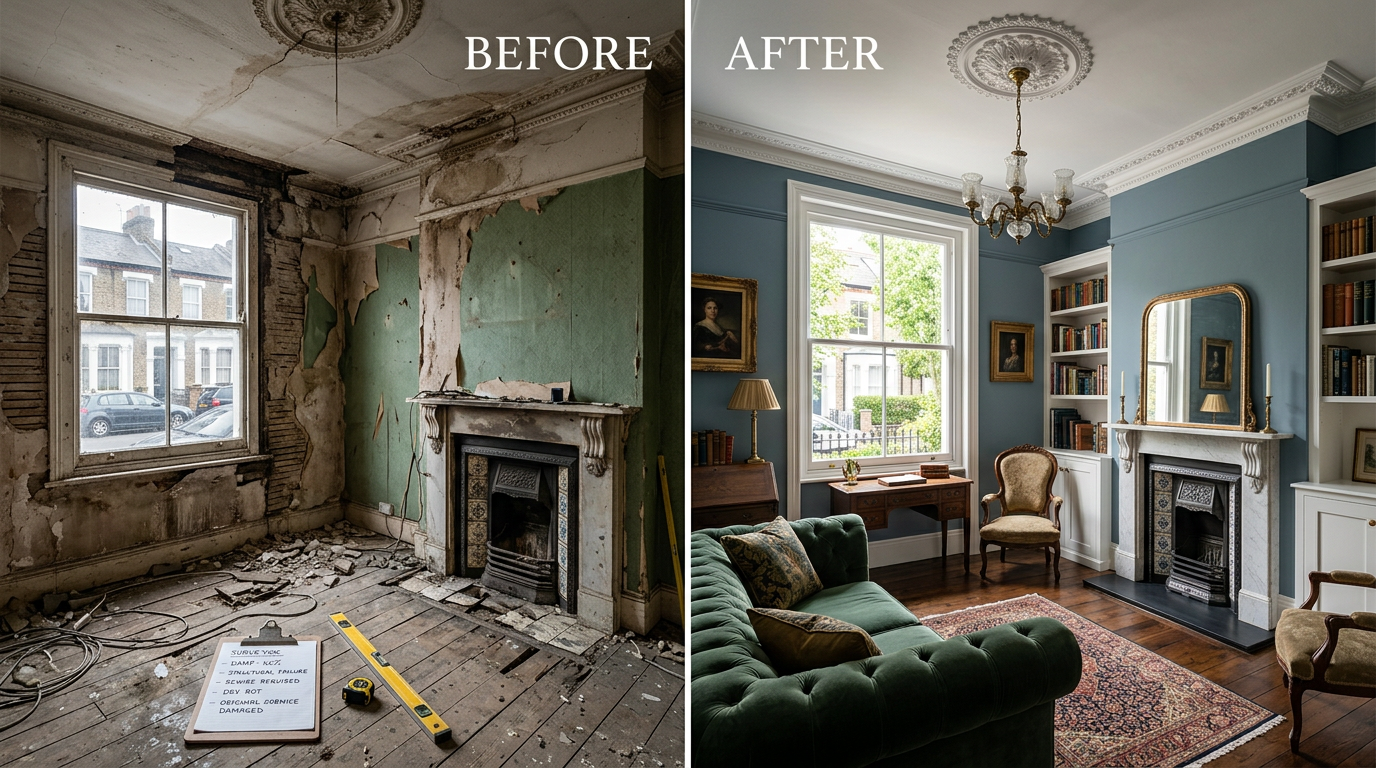
Many buyers and homeowners commission a building survey before they purchase or renovate a property, receive the report, and then file it away — acting on some findings, ignoring others. But a well-used building survey isn't just a tick-box exercise or a negotiation tool. Used properly, it is the foundation of a successful, well-sequenced renovation project. This case study — drawn from a real Pimlico Surveyors commission (with client details changed for confidentiality) — illustrates exactly how this works in practice.
The Property: A Victorian Mid-Terrace in Battersea
Our client — let's call her Emma — purchased a four-bedroom Victorian mid-terrace in Battersea, SW11. Built circa 1885, the property had been in the same family for over 40 years and had seen a series of piecemeal improvement works over the decades — a conservatory extension, a partial kitchen renovation, a new boiler, and various internal redecoration. Emma's plan was ambitious: a full rear extension, loft conversion, and whole-house refurbishment.
Before exchanging contracts, Emma commissioned a full RICS Building Survey from Pimlico Surveyors. Her initial expectation was that the report might reveal a few cosmetic issues and perhaps some minor repairs. What it actually found fundamentally changed her renovation plans — and saved her an estimated £35,000–£45,000 in abortive and unforeseen costs.
What the Building Survey Found
Finding 1: Defective Chimney Stack Flaunching
The main rear chimney stack had severely deteriorated flaunching (the mortar that holds the chimney pots in place) and loose pointing. Left unattended, the stack would have been a source of significant water ingress to the upper floors. More critically, the stack sat directly above the proposed loft conversion area — meaning any loft works would have had to stop immediately upon discovering the problem, at significant additional cost.
Outcome: Emma negotiated a price reduction of £4,500 to cover chimney repairs. The chimney was rebuilt as the very first item in her renovation programme, before loft works began — saving an estimated £8,000–£12,000 in disruption and remediation costs that would have been incurred mid-programme.
Finding 2: Failed Concrete Ground Floor Slab
The previous owners had replaced the original suspended timber ground floor with a concrete slab sometime in the 1980s — common in London terraces of this era. Our survey found that the slab had a failed damp-proof membrane (DPM), which was allowing ground moisture to rise through the screed. In several areas, the floor was showing signs of moisture-related deterioration, and the kitchen units installed on top of it were showing early signs of rot at their bases.
Outcome: Emma had been planning to reuse and simply redecorate the existing kitchen. The survey confirmed this was not viable — but more importantly, it meant she could budget correctly from the outset for a full ground floor screed and DPM replacement as part of her kitchen extension project, rather than discovering the problem mid-renovation.
Finding 3: Inadequate Roof Covering to Rear Slope
The rear roof slope (over the single-storey kitchen extension) was covered in felt — not slates — and had reached the end of its serviceable life. Several areas of felt were showing cracks, and there was evidence of previous patching repair. Water ingress had already caused some damage to the ceiling joists below.
Outcome: The rear roof covering was included in the renovation specification from the start, properly co-ordinated with the planned rear extension. Had Emma proceeded without the survey, she might have completed the internal works and decoration only to have a leaking roof require them to be substantially undone.
Finding 4: Inadequate Structural Support to Party Wall Opening
The previous owners had created an open-plan ground floor by removing a section of the ground-floor party wall — the wall shared with the neighbouring property. Our survey found that the steel beam inserted to carry the load above the opening was undersized for the span, and the padstone (concrete bearing plate) at one end was inadequately sized and positioned. Crucially, this was a party wall matter — any remedial works would need to be undertaken under the Party Wall etc. Act 1996.
Outcome: Emma commissioned a structural engineer to prepare calculations and a specification for remedial works, and our party wall team managed the required notices and award with the adjoining owner. The works were included in the main renovation contract — avoiding what would otherwise have been a discovery mid-project that could have required emergency temporary propping and major disruption.
Finding 5: Sub-Floor Void Ventilation Deficiency
The ground floor of the front reception room still had its original suspended timber floor. The sub-floor void had been partially blocked by garden soil build-up against the external walls, reducing ventilation to the under-floor space significantly. Several ground-floor joists showed early signs of wet rot at their bearing ends.
Outcome: Ventilation improvements and targeted joist repairs were added to the project specification. The total cost of the remedial works was modest — approximately £2,200 — but had the issue been allowed to progress unchecked, full replacement of the ground floor would have cost £15,000+.
The Bigger Picture: Survey as Project Planning Tool
What made the difference for Emma was not simply identifying the defects — it was using the survey report as the foundation for sequencing and scoping her renovation project. Working with her architect and main contractor, she translated the survey findings into a prioritised schedule of works that addressed structural and fabric issues before cosmetic and decorative works, and ensured that all elements of the project were properly coordinated.
The building survey report also proved invaluable in obtaining realistic contractor quotes — because the full scope of works was known from the outset, rather than being discovered (and re-quoted) in stages during the project.
"Emma told me after completion that the survey was the best money she spent on the whole project. Not because of the price reduction she achieved — though that helped — but because it gave her the information she needed to plan and budget properly. That's exactly what a good building survey should do."
Tips for Using a Building Survey in Your Renovation
- Share the survey report with your architect and main contractor before they finalise scope and pricing
- Use the survey's condition ratings (1, 2, 3) to prioritise urgent items that must be addressed first
- Follow up on any recommendations for specialist investigations — drainage surveys, structural engineer reports, damp specialist assessments
- Call your surveyor after you receive the report — a good firm will talk you through the findings and answer your questions
- Use the repair cost estimates in the survey to support price renegotiation before exchange
Planning a Renovation? Start with the Right Survey.
An RICS Building Survey from Pimlico Surveyors gives you the detailed, actionable information you need to plan your renovation with confidence. Get a free, no-obligation quote today.
Get a Free Quote About Building Surveys